
Frequently Asked Questions
Straight answers on stretch film performance, sustainability, and cost — the questions Paragon Films customers ask most.
Performance and testing
What makes Paragon Films different from other stretch film manufacturers?
Paragon Films concentrates on film engineered to run thinner to use less plastic, hold loads more securely, and lower cost per pallet.
Paragon Films does not simply sell film. The company works with customers to optimize load containment, reduce film usage, lower cost per pallet, and improve operational efficiency through testing, analysis, and ongoing support.
That specialized focus allows Paragon Films to move quickly, adapt to customer needs, and provide deeper technical expertise, backed by decades of stretch film manufacturing and application experience.
How do I choose the right stretch film for my operation?
Start with an on-site evaluation of four variables: your current wrapping process, your equipment, your product loads, and your sustainability goals. A Paragon Films representative assesses all four and recommends a film matched to that specific application rather than applying a one-size-fits-all specification.
This optimization process is what maximizes performance and value. The right film for one operation is frequently the wrong film for another one that is running different loads on different equipment.
Find your Paragon Films sales representative to schedule an on-site evaluation.
How can I test whether a new stretch film will outperform my current film?
Through side-by-side testing rather than specification comparison. Paragon Films conducts head-to-head assessments measuring load containment, film consumption, and cost per pallet wrapped against your current film, and provides the resulting data as the basis for the decision.
Performance depends on the application, which is why Paragon Films recommends testing and evaluation over assumptions or generic claims.
At The Experience Center, customers see stretch film performance firsthand, participate in hands-on testing, explore optimization opportunities, and work directly with technical experts to identify the best solution for their operation, providing real-world validation rather than specification sheets.
Sustainability and compliance
Can you improve packaging sustainability without giving up performance or cost savings?
Yes, and that principle is what Paragon Films calls Sustainability Without Sacrifice™. Businesses should not have to choose between protecting products, controlling costs, and reducing environmental impact. Ultra high-performance films cut the material required per each pallet that is wrapped, which lowers plastic consumption and packaging spend at the same time.
Paragon Films' specialized focus on stretch film supports continued innovation in solutions that balance sustainability, performance, and operational efficiency-producing measurable results rather than sustainability claims.
Does Paragon Films offer stretch film with post-consumer recycled (PCR) content?
Yes. Paragon Films offers products with certified post-consumer recycled (PCR) stretch film, certified through SCS Global Services. These products are designed to reduce virgin plastic use while meeting performance requirements and support circularity initiatives and recycled-content targets.
PCR options are available across product lines designed to help organizations meet sustainability commitments without a performance tradeoff.
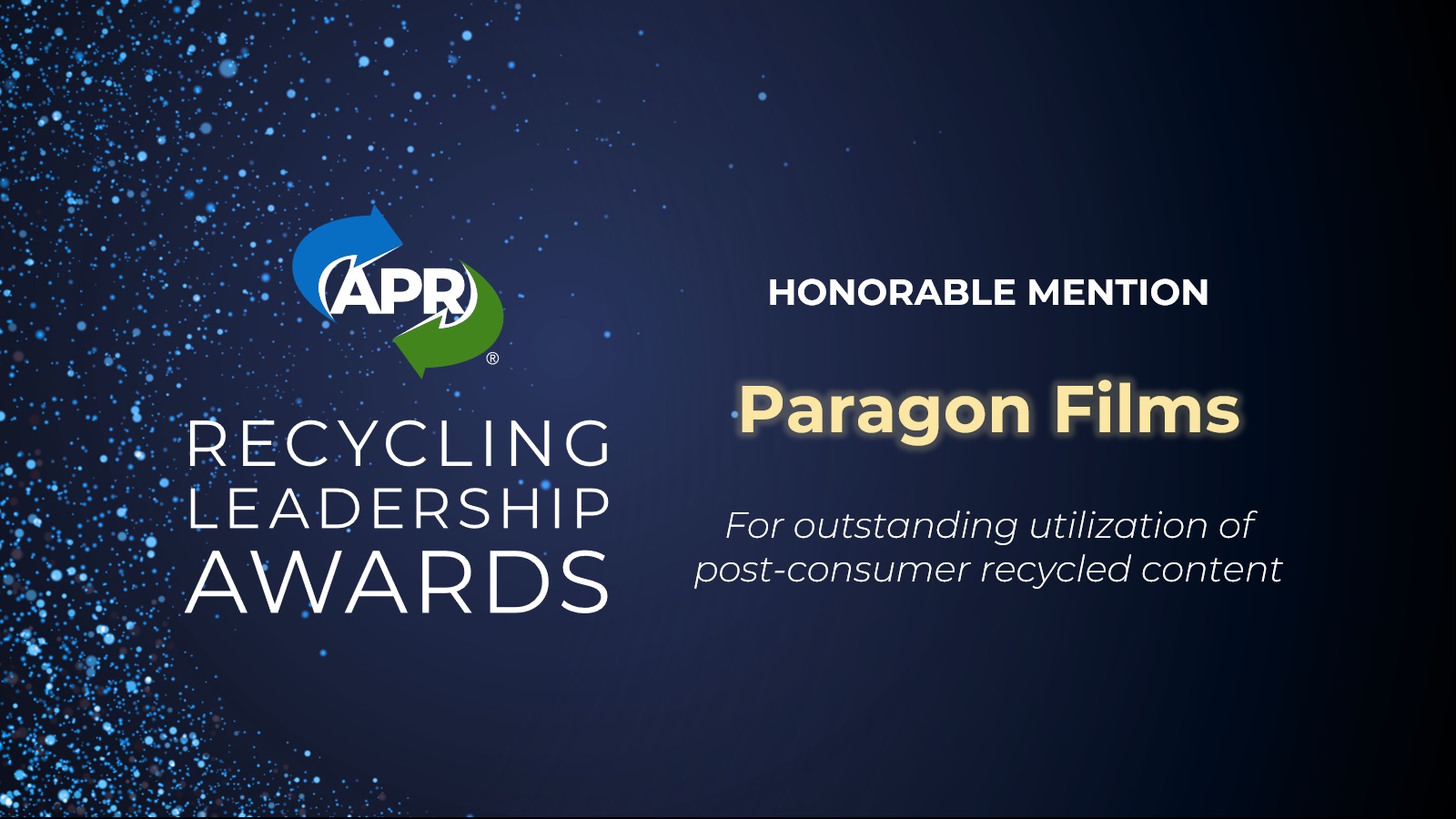
Paragon Films received an honorable mention in the Association of Plastic Recyclers (APR) Recycling Leadership Awards for outstanding utilization of post-consumer recycled content.
How can I find out how much stretch film my operation is wasting?
Paragon Films runs a proprietary analysis using the Green Client Analysis Tool (GCAT), which identifies where film is being over-applied, where pallet performance can improve, and what sustainability gains are available. A client analysis report quantifies those opportunities in measurable operational and environmental terms.
The output is a documented set of improvements specific to your operation, not a general recommendation.
How can stretch film choices reduce EPR fees and support compliance?
Extended Producer Responsibility (EPR) fees assessments often include packaging weight, so reducing the film applied per pallet can reduces the fee base directly. Paragon Films offers recyclable stretch films, SCS Global-certified PCR products, and films that use less virgin resin.
As members of the Association of Plastic Recyclers, the Sustainability Packaging Coalition, and other sustainability-focused organizations, our team can also assist customers by providing resources to assist with reporting and compliance initiatives.
Cost and value
Can you use less stretch film without sacrificing load stability?
Yes. Ultra-high-performance stretch films can stretch further and contain loads at lower gauges, so many operations wrap the same pallet using measurably less film while maintaining or improving load stability. The savings compound across fewer roll changes, lower material consumption, and reduced cost per pallet wrapped.
Results depend on process optimization. Paragon Films evaluates the entire wrapping operation, not just the film itself, to identify where cost savings, efficiency gains, and load performance improvements are available.
Because stretch film is the company's sole area of expertise, that evaluation goes deeper than a product substitution.
What actually determines stretch film cost, roll price or cost per pallet?
Cost per pallet wrapped. The lowest roll price frequently produces a higher total packaging cost, because a lower-performing film requires more material per load and more roll changes, and carries greater risk of freight damage and higher EPR fees.
Paragon Films focuses on overall packaging performance rather than unit price alone. That specialized expertise surfaces opportunities that are not visible when stretch film is evaluated on roll cost alone.

